





A Complete Guide to MOPS Order No.176: Shifting from Document Review to Practical Remote Technical Inspection
2026-10-16 11:49:38
1
A Complete Guide to MOPS Order No.176: Shifting from Document Review to Practical Remote Technical Inspection
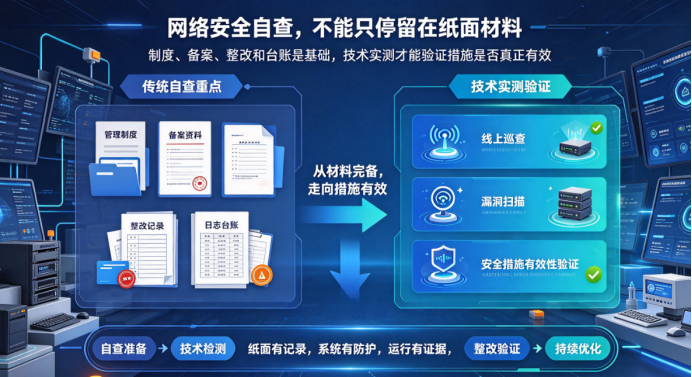
Previously, enterprises conducting cybersecurity self-inspections mostly compiled management systems, filing documents, rectification records and log ledgers. However, as cybersecurity inspections increasingly adopt online patrols, vulnerability scanning and other technical means, merely preparing paper documents is no longer sufficient to prove that cybersecurity controls are functioning effectively.
The Measures for the Supervision and Inspection of Cyberspace Security by Public Security Organs (Ministerial Order No.176 of the Ministry of Public Security), effective October 1, 2026, further clarifies the scope, methods and priorities of cyberspace security supervision and inspection. For enterprise campuses, this means cybersecurity management can no longer remain at the level of system formulation and document archiving. It must also focus on the actual operational status of networks, effectiveness of technical protection measures, and the capability to rapidly locate and remediate risks once they emerge.
I. Key Changes to Enterprise Cybersecurity Inspections under Order 176
1. Diversified inspection methods, with online patrols becoming a core tool
Pursuant to Article 4 of Order 176, public security authorities may carry out online patrols through cyberspace information inspection, information verification capability tests and vulnerability scanning to promptly identify cyberspace security risks. For qualified network facilities and information systems, public security organs at or above prefecture-level cities may conduct remote detection including vulnerability probing and penetration testing.
This does not mean all enterprises will be subject to penetration testing at any time. Such remote detection has clear scope and procedural requirements. Inspectors generally notify enterprises of the inspection window and coverage three working days in advance, and must not disrupt or damage the normal operation of network facilities and information systems.
For enterprises, the key takeaway is that cybersecurity risks can now be identified via online technical tools. Daily management can no longer rely solely on periodic on-site audits and manual reports. Internet attack surfaces, system vulnerabilities and the real operational status of security defenses all require continuous governance.
2. Broader inspection scope; actual network operational status matters equally
Article 7 of Order 176 defines inspection priorities, including filing and information submission by network-connected entities, implementation of cybersecurity management systems, retention of user registration data and internet access logs, classified protection obligations, defense against network attacks and intrusions, vulnerability remediation, data security and personal information protection.
These items are interrelated and cannot be verified merely through standalone policy documents. For example, even if an enterprise drafts a terminal access policy, the rule is not truly enforced if unknown devices can freely connect to the internal network. Likewise, deployed security appliances deliver little protection if alerts are ignored and vulnerabilities remain unpatched for long periods.
Enterprises therefore need to combine policies, technical controls and real-world operational status to build an inspectable, verifiable and remediable security management workflow.
3. Establish verification and remediation closed-loop after risk detection
Order 176 stipulates that risks uncovered via online patrols and remote detection shall be verified; on-site inspections may be adopted for offline verification when necessary. During on-site visits, inspectors can examine the running status of security technical measures and perform technical testing such as vulnerability probing and penetration testing.
This means enterprises should not treat security inspections as a one-time document submission task. The recommended practice is to build a full closed loop: risk discovery, issue confirmation, remediation and re-verification. It must clarify who is responsible for each problem, deadlines for resolution, and validation criteria to confirm effective remediation.
II. Practical Cybersecurity Readiness for Enterprise Campuses
1. Start from the network perimeter to enhance vulnerability detection and defense
Campus networks typically connect office PCs, servers, surveillance cameras, access control equipment, production terminals and various IoT devices. The wide variety of hardware and inconsistent system versions mean any weakly managed access point may become an entry point for threats.
Enterprises should regularly inventory publicly exposed services, network devices and business systems, conduct timely vulnerability checks, close unnecessary ports, and configure protection policies based on business criticality. For internet-facing systems, deploy firewalls, intrusion prevention systems and web application firewalls to mitigate risks from malicious access, network attacks and exploitation of application-layer vulnerabilities.
AINOPOL can align with campus network architectures and integrate network access and security protection via secure optical gateways, configuring access control, intrusion prevention and web application protection according to deployment requirements. Security hardware is not a “set-it-and-forget-it” solution; enterprises must continuously monitor alerts, update policies and handle risks.
2. Manage every access terminal to eliminate internal network blind spots
Campus network risks do not only stem from external attacks. Dumb terminals such as cameras, access controllers and printers often lack robust local security controls. Without access permission constraints, unregistered devices may join business networks, raising risks of unauthorized access and lateral movement.
Enterprises can adopt terminal registration, identity authentication, access whitelisting and network segmentation to bind device identities with permitted network access scopes. Assign appropriate access rights for different business terminals to avoid unnecessary connectivity between office devices, security equipment and core business systems.
AINOPOL’s integrated Communication & Security solution supports port binding, terminal whitelisting, identity authentication and network isolation to refine campus access management. For devices incapable of traditional client-side authentication, formulate tailored access strategies based on device characteristics and business requirements to reduce management blind zones.
3. Link logs, authentication and auditing to ensure incident traceability
Cybersecurity inspections evaluate not only whether security controls exist, but also whether statutory compliance obligations are fulfilled. Enterprises shall record, retain and manage user registration information and internet access logs in accordance with applicable regulations, and ensure records can be queried and verified when required.
If the network only logs partial egress traffic without linking user identities, access terminals and browsing activities, reconstructing incidents will become difficult after anomalies occur. Log management must be built alongside real-name authentication, terminal access control and network auditing, with clear recording scope, retention periods, query permissions and anomaly response workflows.
Leveraging the integrated authentication and logging capabilities of AINOPOL Dream Series Secure Optical Gateways, the native “Communication & Security” integrated solution adopts full-optical network as the foundation, audio & video as the engine, and security as the protective shield. It helps enterprises centrally manage network activity records. During deployment, verify log coverage, retention duration and query capabilities against applicable regulations and business scenarios. The activation of equipment alone does not equate to full compliance.
Ministerial Order No.176 further defines supervision methods including online patrols, remote detection and on-site verification. For enterprise campuses, what needs to change is not the format of document preparation, but the day-to-day operation mode of cybersecurity work: clear asset inventory, manageable connected devices, traceable user behavior, detectable security risks and verifiable remediation results.
AINOPOL provides a foundation combining network transmission and security management for campuses through full-optical networks, secure optical gateways, terminal access control, identity authentication and log auditing. Enterprises should continuously conduct asset inventory, vulnerability scanning, log verification and emergency drills in line with their business and applicable regulations.
Compliance is not about hastily compiling documents before inspections. It requires cybersecurity controls to remain effective in daily operations. Only by embedding policy requirements into devices, accounts, traffic and logs can enterprises better cope with technical inspections and strengthen the campus network’s resilience against real security threats.
FAQ
Q: What is the core difference between Order 176 and the former Order 151?
A: There are three fundamental changes. First, regulatory scope expands from “internet security” to “cybersecurity + data security + information security”. Second, inspection methodology upgrades from “on-site document review” to a three-tier mechanism: online patrol + remote detection + on-site verification. Third, newly added compliance obligations cover data security protection, personal information protection, algorithm security subject responsibility and other items absent in Order 151.
Q: Is advance notice required for remote detection?
A: Among online patrol activities (vulnerability scanning, information verification capability tests, etc.), information verification capability tests require three working days’ advance notice of patrol time and scope. Remote technical detection (vulnerability probing, penetration testing, etc.) also requires three working days’ prior notification of inspection time and scope. Vulnerability scanning under online patrols does not require prior notice.
Q: What can public security remote detection identify?
A: Remote detection can verify whether authentication systems are truly operational, whether log storage is valid and fields complete, which ports are exposed on the internal network, whether terminals retain default passwords, and weak-password vulnerabilities on dumb terminals. Online inspection can determine whether real-name authentication is active, or merely a static authentication webpage for show.
Related Articles


