


No Dedicated Network Administrator Required! All-Optical Cloud Management Cuts Annual O&M Costs for Enterprises
2026-09-12 11:54:52
9
No Dedicated Network Administrator Required! All-Optical Cloud Management Cuts Annual O&M Costs for Enterprises
Enterprise networks keep growing in terms of connected devices, yet what truly troubles managers goes far beyond hardware procurement expenses.
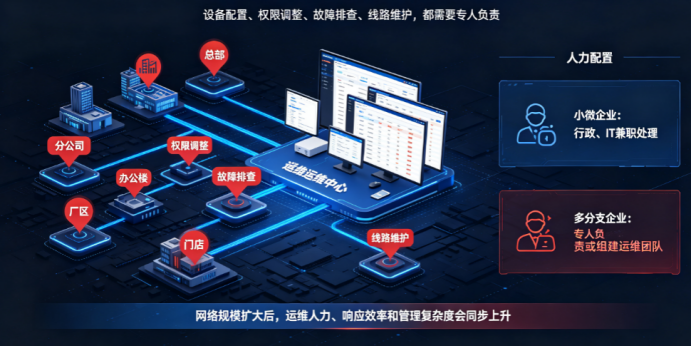
With headquarters, subsidiaries, office buildings, factory campuses and retail stores all online, someone must handle device configuration, permission adjustments, fault troubleshooting and line maintenance. Small and micro enterprises without dedicated network admins assign these tasks to administrative or part-time IT staff. Businesses with multiple branches may need to hire dedicated personnel or even build an in-house O&M team.
The larger the network scale, the higher the cost of the traditional on-site maintenance model that relies on manual device monitoring and field visits.
Instead of recruiting more network engineers, combining all-optical networks with centralized cloud management shifts network operations from on-site handling to remote control, enabling enterprises to operate larger networks with fewer staff.
I. Why Enterprise Networks Are Becoming Harder to Manage
- Dispersed devices make fault location difficult
Network work does not end once deployment finishes. Switches, wireless APs, gateways, ONUs and other hardware are spread across different floors, zones and even remote branches. When outages or access anomalies occur, technicians often need to inspect devices one by one.
For enterprises without professional network administrators, the usual practice is to fix problems only where failures appear. This approach wastes time, and inadequate technical judgment may lead to recurring faults.
- Frequent network configuration changes consume substantial manpower
Employee onboarding, offboarding and job transfers all trigger updates to network access permissions. Adding new offices, cameras, access control units or wireless terminals also requires network configuration work.
If every adjustment requires manual login to individual devices to modify settings, repetitive workloads surge as the network expands. Inconsistent configurations across locations can also introduce new management risks.
- Expanding branches rapidly push up on-site maintenance costs
The headquarters may have staff to resolve network issues, but faults at remote subsidiaries, retail outlets or factory sites are far more complex than simply editing settings via a backend portal.
In the past, network admins might need to travel onsite, coordinate local personnel or contact device vendors for field support. A single failure incurs not just repair fees, but also hidden losses from travel expenses, labor costs and business disruption.
II. All-Optical Cloud Management: Transform Manual On-Site Maintenance into Centralized Remote Administration
Zhihui Guangxun integrates all-optical networks with EAAS cloud management capabilities, consolidating scattered network hardware, terminals and policies in the cloud. Enterprises can perform daily network administration without a large on-site maintenance team.
- One cloud platform to manage multi-site networks
Network devices across headquarters offices, branch sites and different buildings within a campus can be brought under unified management. Administrators can remotely monitor network health and centrally configure and maintain hardware without frequent site visits.
For small and micro enterprises lacking dedicated network admins, this reduces heavy repetitive basic maintenance tasks. For multi-branch companies, it unifies previously fragmented network management.
- Template-based policies eliminate repeated configuration
Many network settings are reused across different enterprise locations, such as staff networks, guest networks, surveillance terminals and departmental access permissions.
Zhihui Guangxun supports template management for commonly used network policies. Predefined policies can be reused directly when adding new zones or devices to avoid repetitive configuration on every piece of hardware. Combined with permission grading, different users can manage resources within their authorized scope, cutting configuration workload and preventing risks from unrestricted network modification.
- Remote fault localization reduces field visits
When network anomalies arise, centralized cloud management helps O&M staff quickly check device and network status, tracing issues from the overall network down to specific zones, hardware or terminals.
Problems that previously required technicians to check each device in weak-current rooms can first undergo remote diagnostics via the cloud. For faults that cannot be fixed remotely, the scope of the issue can be assessed upfront before dispatching staff, minimizing unnecessary site visits and repeated troubleshooting.
III. Simplified All-Optical Architecture for Further O&M Cost Reduction
Cloud management addresses how networks are managed, while all-optical networks determine how many assets require management.
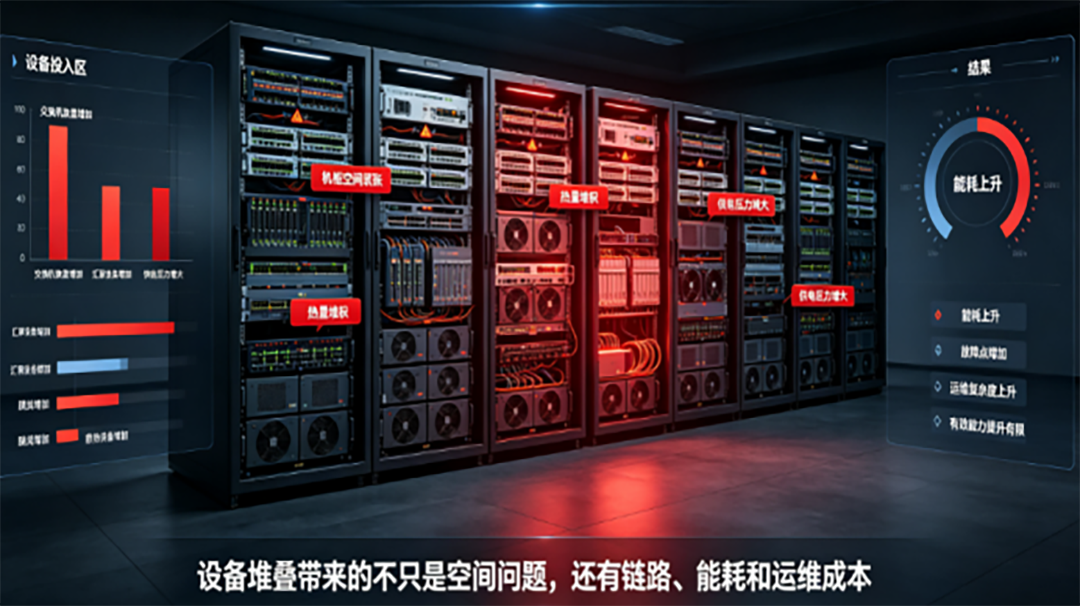
Traditional campus networks often feature multi-layer switching hardware, complex copper cabling and numerous intermediate nodes. More devices mean more potential failure points and heavier maintenance workloads.
Zhihui Guangxun’s all-optical networks are built with OLTs, passive splitters and ONUs to reduce stacked active intermediate equipment. Office, wireless, surveillance and access control services all run on a unified fiber infrastructure.
Fewer devices and simpler links reduce the pool of assets requiring maintenance. Paired with centralized cloud management, enterprises cut long-term O&M costs from two angles: fewer physical devices and less manual labor.
For businesses handling critical operational data, the converged connectivity-security framework can be adopted. Communication and security capabilities are designed in tandem while maintaining unified network management and stable operation, adding safeguards for the transmission of vital data.
Enterprises gain more than just a remotely accessible management portal — they get a lightweight all-optical cloud management system optimized at both network architecture and operational levels.
FAQ
Q: Can the all-optical cloud platform manage networks well without a dedicated network administrator?
A: Yes. The EAAS cloud platform supports unified device onboarding, automatic topology discovery, proactive fault alerts and one-click remote recovery. Over 80% of common faults can be resolved remotely. General administrative staff can complete daily O&M after brief training.
Q: Does the all-optical cloud management platform require additional server procurement?
A: No. EAAS is a cloud-based SaaS platform. Users simply log in with an account. No server maintenance or software upgrades are needed.
Q: Can multiple branches and campuses be managed uniformly?
A: Yes. The EAAS platform supports unified multi-project management. Headquarters can view network status across all branches via the web portal, with centralized policy orchestration and unified device onboarding. Branch staff can handle daily O&M via the mobile APP.
Related Articles